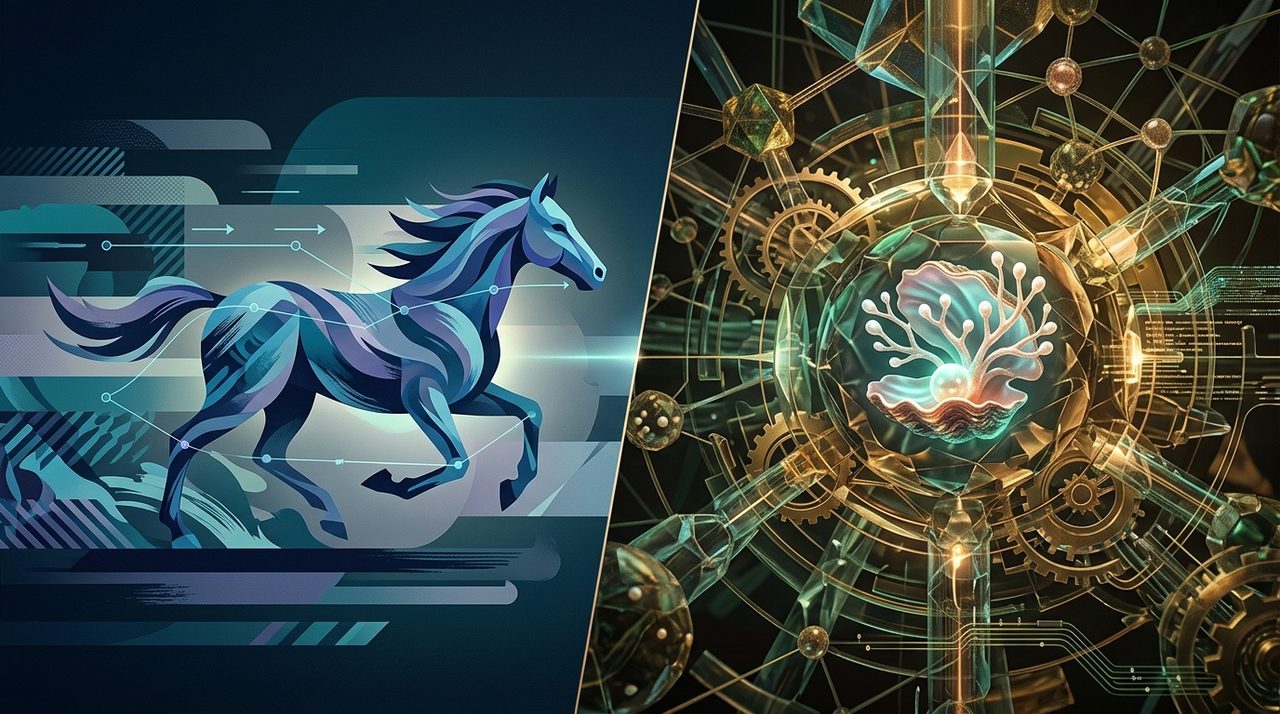
Happy Oyster vs Happy Horse

Happy Oyster is Alibaba's 3D world simulator for interactive environments, while Happy Horse is its sister 2D video model that topped global leaderboards for text-to-video and image-to-video generation.

Happy Oyster vs Happy Horse comparison of Alibaba's 3D and 2D AI models

Key facts

Quick facts

Same team

Verified

Both models are developed by Alibaba's ATH Innovation Division (Future Life Lab under Taotian Group)

Happy Horse benchmark

Verified

Ranked #1 on Artificial Analysis for text-to-video (1,389 Elo) and image-to-video (1,416 Elo)

Happy Horse architecture

Verified

Transfusion architecture with unified 40-layer Transformer, joint audio-video denoising in single pass

Core distinction

Verified

Happy Oyster produces interactive 3D worlds; Happy Horse produces 2D video clips

Comparison notes

Happy Oyster and Happy Horse are sister models from the same Alibaba team. Understanding their relationship is key to understanding Alibaba's AI strategy: Happy Horse dominates 2D video generation, and Happy Oyster extends the same team's technology into interactive 3D worlds.

Same team, different dimensions

Both models come from the Future Life Lab team at Alibaba's Taotian Group, part of the ATH Innovation Division. The team is led by Zhang Di, former VP of Kuaishou and former head of Kling AI technology. This is the same team that built Kling into a market leader before moving to Alibaba.

Happy Horse appeared on Artificial Analysis around April 7, 2026 without identifying its creator. It climbed to the #1 position in both text-to-video and image-to-video rankings before Alibaba confirmed ownership on April 10. Happy Oyster was announced on April 16, 2026 as the 3D counterpart.

How they compare

| Feature | Happy Oyster | Happy Horse | |---|---|---| | Output type | Interactive 3D worlds | 2D video clips | | Dimension | 3D (explorable) | 2D (viewable) | | Core modes | Directing + Wandering | Text-to-video, image-to-video | | Audio | Native co-generation | Joint audio-video generation in single pass | | Architecture | Native multimodal | Transfusion (40-layer unified Transformer) | | Benchmark ranking | No public scores | #1 text-to-video (Elo 1,389), #1 image-to-video (Elo 1,416) | | Interactivity | Real-time scene adaptation | Linear playback | | Access | Limited early access | API planned April 30; open source coming | | Primary use | Games, VR, simulation | Film, social media, marketing |

Happy Horse's track record

Happy Horse is currently the top-ranked video generation model globally. Its Elo score of 1,389 for text-to-video beat Seedance 2.0 by nearly 115 points. In image-to-video, it set a new record with an Elo of 1,416. These are not marginal leads; they represent a significant gap over all competitors.

The model uses a Transfusion architecture with a single unified 40-layer Transformer. Text tokens, reference image latents, and noisy video and audio tokens are jointly denoised within one token sequence. The first and last 4 layers use modality-specific projections while the middle 32 layers share parameters across all modalities. It generates video and audio together in a single pass.

Happy Oyster's new territory

Happy Oyster takes the ATH team's generation capabilities into three dimensions. Instead of producing a flat video you watch, it creates a world you enter. The Directing mode gives creators control over scene construction, while the Wandering mode allows free exploration of generated environments.

The transition from passive generation to active simulation is how Alibaba describes the leap. For applications where users need to interact with generated content, including game prototyping, VR experiences, architectural visualization, and training simulations, 3D worlds are categorically more useful than video clips.

Complementary, not competitive

These models are not competing with each other. They represent two layers of Alibaba's generative AI stack:

  • Happy Horse handles 2D content: marketing videos, social media clips, film pre-visualization, and any workflow where the final product is a video file.
  • Happy Oyster handles 3D content: game worlds, VR environments, simulations, and any workflow where the final product is an interactive space.

A game studio could use Happy Oyster to generate explorable environments and Happy Horse to create cinematic trailers for the same project. The shared ATH team and likely architectural similarities suggest deeper integration between the two models may emerge as both mature.

Availability timeline

Happy Horse's API is scheduled for April 30, 2026, with a full open-source release to follow. Happy Oyster is currently in limited early access with no public API timeline. If you need to start generating content now, Happy Horse is the nearer option.

For evaluating both models as part of a broader AI workflow, Elser.ai provides comparison tools across video and 3D platforms. Read What Is Happy Oyster? for a full breakdown of the 3D model, or see how it compares to its most direct external competitor, HY-World 2.0.

Mixed signal

Some facts are supported, but other details remain uncertain

Happy Horse benchmarks are verified. Happy Oyster is in early access with limited public data. Both come from the same Alibaba ATH team.

Readers should expect careful wording here because public reporting confirms the topic, while some product details still need cautious treatment.

Recommended tool

Done comparing? Start creating.

Skip the wait — try AI video generation right now with a tool that is available today.

Powered by Elser.ai — works independently of any model discussed above.

Try AI Image Animator

Unlock the Happy Oyster Prompt Library

Get tested prompts, comparison cheat sheets, and workflow templates delivered to your inbox.

Free. No spam. Unsubscribe anytime.

FAQ

Frequently asked questions

Are Happy Oyster and Happy Horse from the same team?

Yes. Both are developed by Alibaba's ATH Innovation Division, specifically the Future Life Lab team under Taotian Group, led by Zhang Di.

Which is better?

They serve different purposes. Happy Horse is for video content creation. Happy Oyster is for interactive 3D environments. Choose based on whether you need video or 3D worlds.

When will Happy Horse be publicly available?

Happy Horse API access is planned for April 30, 2026, with full open-source release including GitHub and model weights to follow.

Can I use both together?

Potentially. Happy Horse could generate marketing video for a product built with Happy Oyster's 3D environments. The shared ATH architecture may enable tighter integration over time.