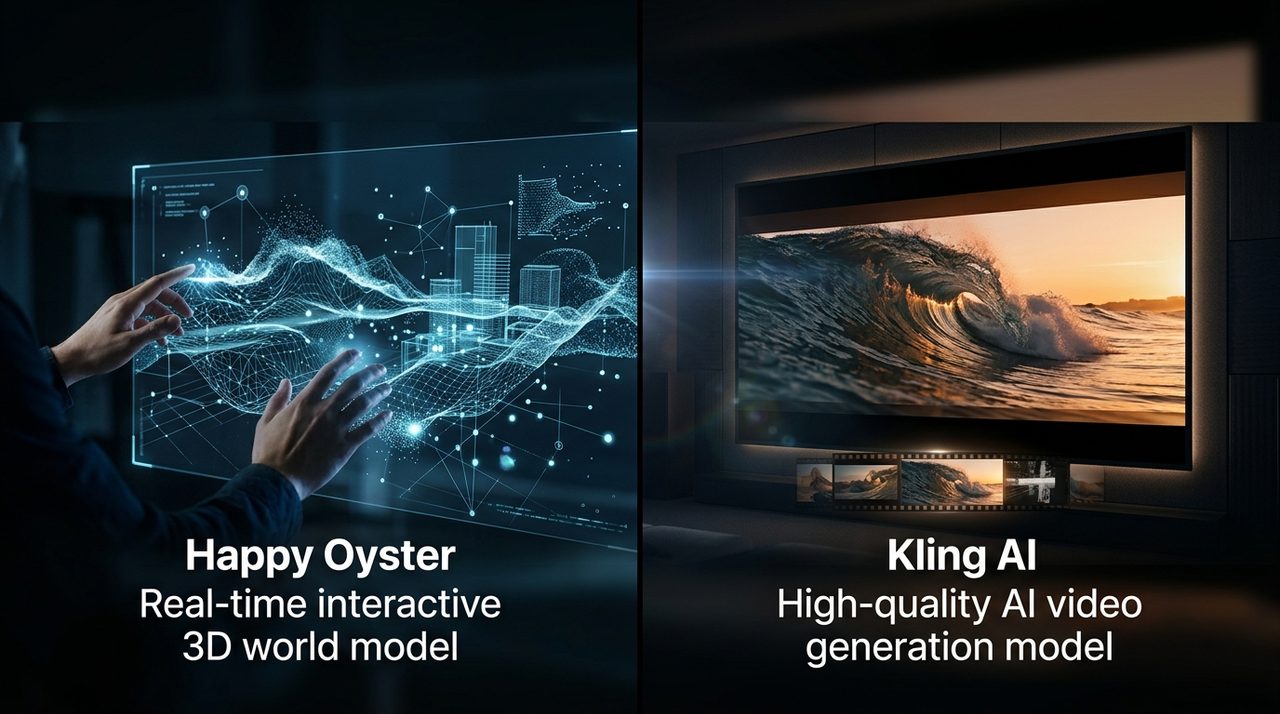
Happy Oyster vs Kling

Happy Oyster is an interactive 3D world simulator, while Kling 3.0 is Kuaishou's top-ranked 2D video generator with native 4K at 60fps and multi-shot storyboarding.

Happy Oyster vs Kling comparison for 3D world model versus AI video generator

Key facts

Quick facts

Kling 3.0 specs

Verified

Native 4K at 60fps, multi-shot storyboarding with 6 camera cuts in a single 15-second clip

Happy Oyster category

Verified

3D world simulator, not a 2D video generator — produces interactive explorable environments

Team connection

Verified

Happy Oyster's ATH team is led by Zhang Di, former VP of Kuaishou and former head of Kling AI technology

Comparison notes

Happy Oyster and Kling share an unusual connection: Happy Oyster's team lead, Zhang Di, previously built Kling at Kuaishou before joining Alibaba's ATH Innovation Division. Despite this shared lineage, the two models solve very different problems. Happy Oyster generates interactive 3D worlds; Kling generates polished 2D video clips.

The team connection

Zhang Di served as VP of Kuaishou and head of Kling AI technology before leading the Future Life Lab team at Alibaba's Taotian Group. This means Happy Oyster benefits from deep expertise in video generation, but applies it to a fundamentally different output format: interactive 3D environments rather than linear video.

What each model does

Happy Oyster, launched April 16, 2026, is a 3D world simulator with Directing and Wandering modes. Users generate three-dimensional environments and explore them in real time, with the model adapting scenes based on interaction. Its native multimodal architecture supports audio-video co-generation.

Kling 3.0, launched February 4, 2026 by Kuaishou, is a unified multimodal video generator. It produces native 4K video at 60fps with synchronized audio in six languages. A standout feature is multi-shot storyboarding: generating up to 6 distinct shots with camera cuts within a single 15-second clip. Kuaishou claims "universe-strongest consistency" for maintaining character identity across angles and scene changes.

Comparison table

| Feature | Happy Oyster | Kling 3.0 | |---|---|---| | Output type | Interactive 3D worlds | 2D video clips (15s, 6 shots) | | Resolution | Not specified | Native 4K at 60fps | | Audio | Native co-generation | Multi-language audio in 6 languages | | Interactivity | Real-time exploration | Linear playback | | Multi-shot | N/A (continuous world) | Up to 6 camera cuts per clip | | Character consistency | Not detailed | "Universe-strongest consistency" | | Architecture | Native multimodal | DiT with 3D VAE | | Revenue | Not applicable yet | 300M yuan ($42M) in Q3 2025 | | Access | Limited early access | Widely available |

Where Happy Oyster excels

Happy Oyster's advantage is dimensionality. While Kling produces the most polished 2D video available, it remains a flat, non-interactive medium. For applications requiring spatial exploration, including game prototyping, VR content, architectural visualization, and simulation, Happy Oyster's 3D output is categorically more useful.

The real-time adaptation capability means generated worlds are not static. As users move through and interact with environments, the model responds and adjusts. This interactive loop is something no video generator, including Kling, can provide.

Where Kling excels

Kling 3.0 is one of the most commercially successful AI video models, generating 300 million yuan in revenue in Q3 2025 alone. Its multi-shot storyboarding feature, which produces multiple camera angles and cuts in a single generation, makes it uniquely suited for narrative content creation.

The 4K at 60fps output quality is industry-leading for AI-generated video. Combined with Kuaishou's Chain-of-Thought reasoning for scene coherence and character consistency across shots, Kling 3.0 delivers production-ready video that requires minimal post-processing.

Kling's broader ecosystem includes the O1 unified multimodal tool (launched December 2025), which consolidates text, video, image, and subject inputs into a single engine. This makes it a complete creative platform rather than a single-purpose model.

Choosing between them

If you are producing video content for viewing, whether for social media, marketing, or film, Kling 3.0 is the more mature and capable tool. If you are building interactive 3D experiences for games, VR, or simulation, Happy Oyster is the relevant model.

The team lineage suggests Happy Oyster may inherit some of Kling's strengths in visual quality and consistency, but applied to a 3D format. As Happy Oyster moves beyond early access, this connection could become its competitive edge.

For a broader evaluation of AI creative tools, Elser.ai offers comparison workflows. Read What Is Happy Oyster? for a full overview, or see how it compares to its most direct 3D competitor, HY-World 2.0.

Mixed signal

Some facts are supported, but other details remain uncertain

Kling benchmarks and features are documented. Happy Oyster is in early access with limited public technical details.

Readers should expect careful wording here because public reporting confirms the topic, while some product details still need cautious treatment.

Recommended tool

Done comparing? Start creating.

Skip the wait — try AI video generation right now with a tool that is available today.

Powered by Elser.ai — works independently of any model discussed above.

Try AI Image Animator

Unlock the Happy Oyster Prompt Library

Get tested prompts, comparison cheat sheets, and workflow templates delivered to your inbox.

Free. No spam. Unsubscribe anytime.

FAQ

Frequently asked questions

Is there a connection between Happy Oyster and Kling?

Yes. Happy Oyster's team at Alibaba ATH is led by Zhang Di, who was previously VP of Kuaishou and head of Kling AI technology.

Does Kling 3.0 support 3D world generation?

No. Kling 3.0 is a 2D video generator. It produces 4K video clips at 60fps but does not generate explorable 3D environments.

Which has better benchmarks?

Kling has documented ELO benchmarks across multiple categories. Happy Oyster has no public benchmark scores as it is a different category of model (3D world simulation vs video generation).