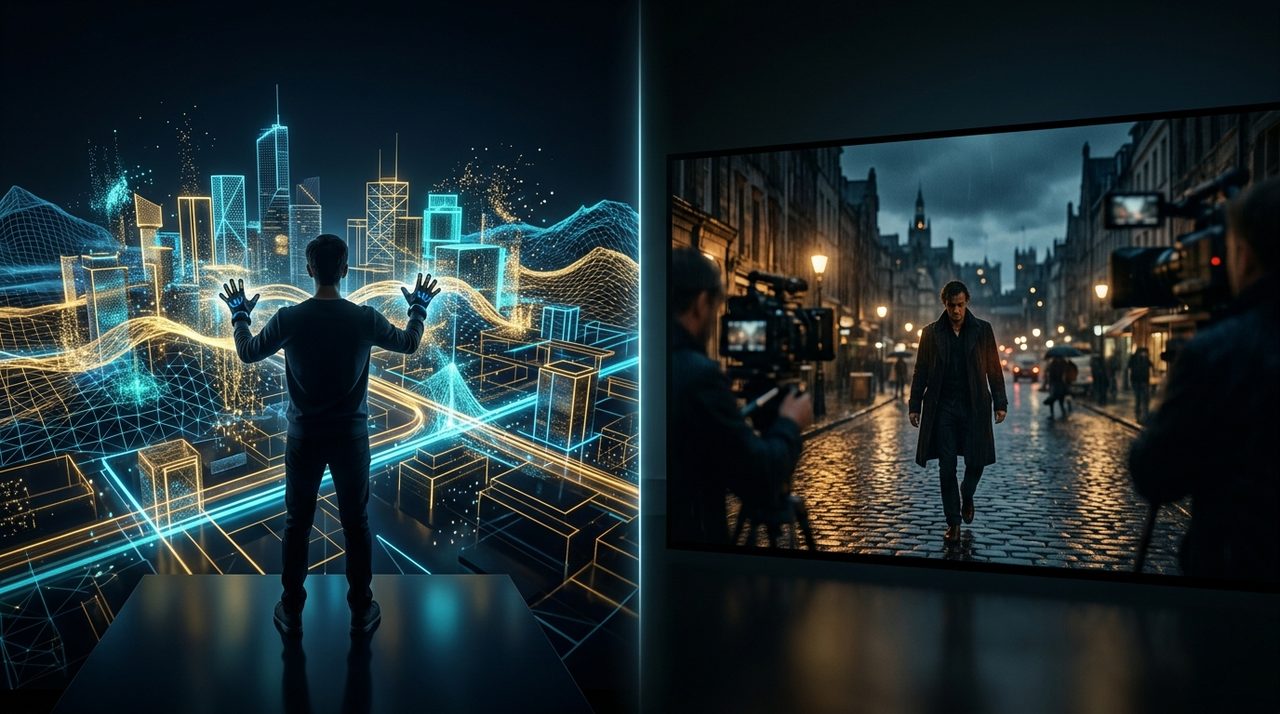
Happy Oyster vs Runway Gen-4

Happy Oyster creates interactive 3D environments for games and VR, while Runway Gen-4 produces cinematic 4K video clips up to 60 seconds for filmmakers and content creators.

Happy Oyster vs Runway Gen-4 comparison for 3D world model versus cinematic video generation

Key facts

Quick facts

Runway Gen-4 resolution

Verified

Native 4K output with up to 60 seconds of continuous video generation

Happy Oyster output

Verified

Interactive 3D worlds with real-time exploration, not linear video

Runway pricing

Verified

Pro starts at $12/month for 625 credits; Pro Unlimited at $76/month

Comparison notes

Happy Oyster and Runway Gen-4 serve different creative workflows. Happy Oyster is a 3D world simulator for interactive content; Runway Gen-4 is a cinematic video generator built for filmmakers. Understanding which you need depends on whether your end product is an explorable environment or a polished video.

What each model delivers

Happy Oyster, launched April 16, 2026 by Alibaba's ATH Innovation Division, generates interactive 3D environments. Users can create and explore scenes through Directing mode and Wandering mode, with the model adapting in real time to user interaction. Its native multimodal architecture supports audio-video co-generation.

Runway Gen-4, released March 2025 with continuous updates through 2026, is widely regarded as one of the most capable cinematic video generators available. It produces up to 60 seconds of continuous video in native 4K resolution, with character consistency across shots, advanced camera movement controls, and physics simulation. The Gen-4.5 update (December 2025) further refined quality and held the top position on Artificial Analysis benchmarks.

Side-by-side comparison

| Feature | Happy Oyster | Runway Gen-4 | |---|---|---| | Output type | Interactive 3D worlds | 2D video clips | | Max resolution | Not publicly specified | Native 4K | | Max duration | Real-time (continuous) | Up to 60 seconds | | Audio | Native co-generation | Not native (via Act-Two for mocap) | | Character consistency | Not detailed | Yes, reference image system | | Camera control | Directing mode | Cinematic movement controls | | Post-generation editing | Real-time adaptation | Aleph in-video text editing | | Pricing | Not announced | $12-$76/month | | Access | Limited early access | Available to all paid plans |

Where Happy Oyster excels

For interactive applications, Happy Oyster offers what Runway cannot: explorable 3D space. Game developers, VR creators, and simulation designers need environments that respond to user input, not linear video that plays and stops. Happy Oyster's Wandering mode allows free navigation through generated worlds, and the real-time adaptation means the scene evolves with the user.

This positions Happy Oyster in a category that traditional video generators have not entered. When your deliverable is an experience rather than a clip, the 3D world approach is fundamentally more suitable.

Where Runway Gen-4 excels

Runway Gen-4 is the professional choice for video production. Its 4K resolution, 60-second generation window, and character consistency system make it the tool filmmakers and agencies actually use. The Aleph editing system allows post-generation text-based modifications without re-rendering entire clips, which saves significant time in production workflows.

Runway also benefits from a mature ecosystem. Integration with third-party models like Kling 3.0 and Sora 2 Pro (as of February 2026), transparent credit-based pricing, and tools like Act-Two for motion capture make it a complete production platform rather than a single model.

For projects involving advertising, film pre-visualization, music videos, and social media content at scale, Runway Gen-4 offers a proven, accessible workflow with predictable costs.

Different tools, different jobs

This is not a case where one model is strictly better than the other. They address different stages of the content creation pipeline and different types of final output. A game studio might use Happy Oyster to generate explorable environments and Runway Gen-4 to produce marketing trailers for the same project.

The more relevant comparison for Happy Oyster is against other 3D world models like HY-World 2.0. The more relevant comparison for Runway is against other video generators like Seedance 2.0.

To explore how these tools fit together in a production workflow, Elser.ai provides cross-platform comparison tools. For more context on Alibaba's model, read What Is Happy Oyster?.

Mixed signal

Some facts are supported, but other details remain uncertain

Runway Gen-4 features are well-documented. Happy Oyster specs are limited due to early access status. Direct quality comparison not possible.

Readers should expect careful wording here because public reporting confirms the topic, while some product details still need cautious treatment.

Recommended tool

Done comparing? Start creating.

Skip the wait — try AI video generation right now with a tool that is available today.

Powered by Elser.ai — works independently of any model discussed above.

Try AI Image Animator

Unlock the Happy Oyster Prompt Library

Get tested prompts, comparison cheat sheets, and workflow templates delivered to your inbox.

Free. No spam. Unsubscribe anytime.

FAQ

Frequently asked questions

Can Runway Gen-4 create 3D worlds?

No. Runway Gen-4 generates linear 2D video clips with cinematic quality. It does not produce explorable 3D environments.

Is Happy Oyster better for filmmaking?

For traditional filmmaking, Runway Gen-4 is the stronger choice with its 4K output, 60-second clips, character consistency, and professional camera controls.

Which has better pricing?

Runway Gen-4 has transparent tiered pricing starting at $12/month. Happy Oyster pricing has not been announced; it is currently in limited early access.