Seedance 2.0 benchmark
VerifiedElo 1,269 on Artificial Analysis text-to-video, ranked #1 as of April 2026
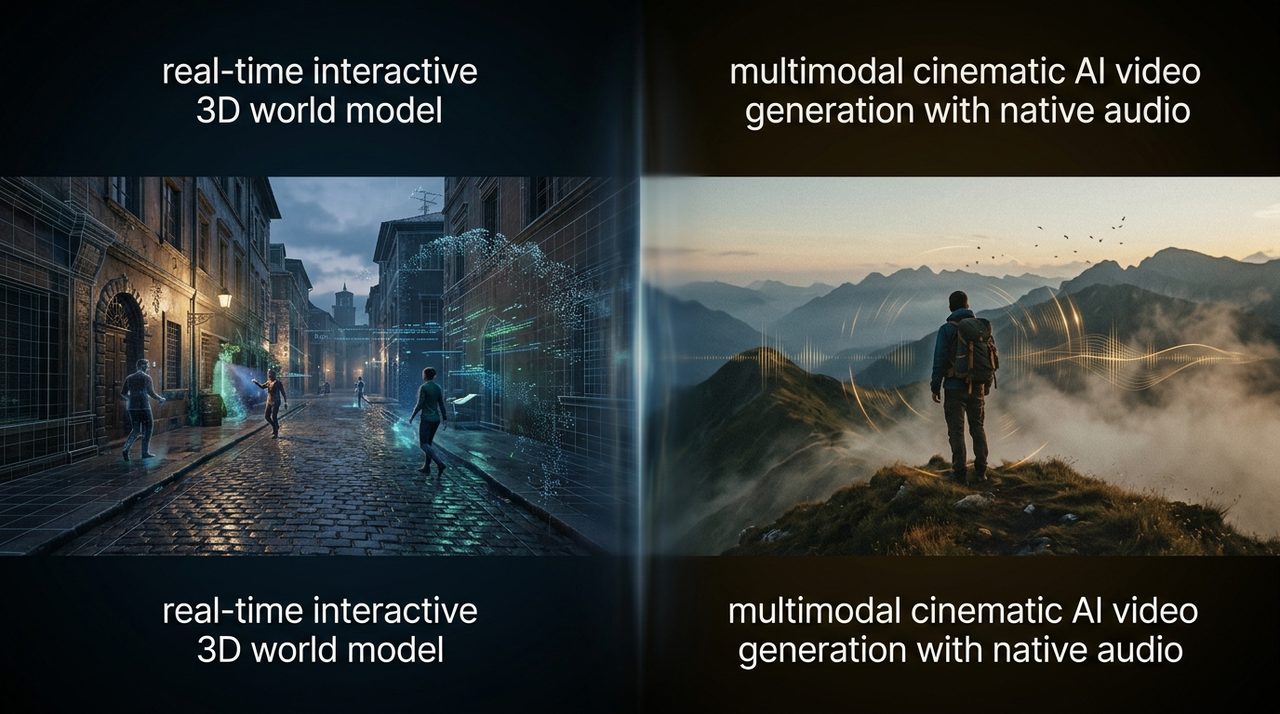
Happy Oyster generates interactive 3D worlds with native audio, while Seedance 2.0 is the top-ranked 2D multimodal video generator with audio-video co-generation in a single pass.

Key facts
Elo 1,269 on Artificial Analysis text-to-video, ranked #1 as of April 2026
Interactive 3D environments with Directing and Wandering modes, not linear video clips
Both support native audio-video co-generation within a single architecture
Up to 2K resolution, clips up to 15 seconds with dual-channel stereo audio
Happy Oyster and Seedance 2.0 are both multimodal AI models with native audio-video generation, but they target fundamentally different output formats. Happy Oyster produces interactive 3D worlds; Seedance 2.0 produces best-in-class 2D video clips. This page breaks down where each model stands as of April 2026.
Happy Oyster, released April 16, 2026 by Alibaba's ATH Innovation Division, is a 3D world simulator. Users generate three-dimensional environments and interact with them through Directing mode (guided creation) and Wandering mode (free exploration). The model supports real-time scene adaptation based on user interaction.
Seedance 2.0, released February 12, 2026 by ByteDance, is a unified multimodal video generator. It produces up to 15 seconds of synchronized audio-video from text, image, audio, and video inputs in a single generation pass. As of April 2026, Seedance 2.0 holds the #1 position on Artificial Analysis for both text-to-video (Elo 1,269) and image-to-video rankings.
| Feature | Happy Oyster | Seedance 2.0 | |---|---|---| | Output type | Interactive 3D worlds | 2D video clips (up to 15s) | | Audio generation | Native co-generation | Dual-channel stereo, lip-sync in 8+ languages | | Resolution | Not publicly specified | Up to 2K | | Interactivity | Real-time exploration and adaptation | Linear playback only | | Input modalities | Text (confirmed), others TBD | Text, image, audio, video (up to 9 images, 3 clips, 3 audio files) | | Benchmark ranking | No public scores yet | #1 text-to-video on Artificial Analysis | | Access | Limited early access | Available via Dreamina, CapCut, fal API | | Use cases | Games, VR, simulation | Film, social media, marketing |
The defining advantage of Happy Oyster is interactivity. While Seedance 2.0 generates video that you watch, Happy Oyster generates worlds that you explore. For game prototyping, VR experiences, simulation environments, and spatial computing applications, this is the more relevant technology.
Happy Oyster's real-time scene adaptation is also unique. The model adjusts generated content based on how users interact with the environment, creating a feedback loop that static video cannot replicate. This positions it closer to a game engine than a video editor.
Seedance 2.0 is the most capable 2D video generator available. Its director-level control system allows precise specification of camera movement, lighting, character motion, and audio cues. The ability to feed up to 9 reference images, 3 video clips, and 3 audio files in a single pass gives creators unprecedented control over output.
For traditional content creation workflows, including film production, advertising, and social media content, Seedance 2.0 is the stronger tool. Its benchmark performance is documented and independently verified, and it is already available through multiple platforms including the public beta API launched April 14, 2026.
Seedance 2.0 has faced copyright controversies, with the Motion Picture Association and Disney raising concerns about the model's ability to reproduce copyrighted characters. ByteDance has stated it will strengthen IP safeguards.
The choice depends entirely on your output requirements. If you need an interactive 3D environment, whether for a game prototype, a VR experience, or a simulation, Happy Oyster is the relevant model. If you need polished video content with synchronized audio for viewing, Seedance 2.0 is the current leader.
Both models share Alibaba and ByteDance's respective multimodal architectures, and both generate audio natively rather than as a post-processing step. But the end products are categorically different.
For evaluating both models as part of a broader AI content workflow, Elser.ai offers comparison tools across video and 3D generation platforms. Read What Is Happy Oyster? for a full breakdown of Alibaba's new model, or see how it stacks up against HY-World 2.0, its most direct 3D world model competitor.
Mixed signal
Seedance 2.0 benchmarks are well-documented; Happy Oyster has no public benchmark scores yet. Direct performance comparison is premature.
Readers should expect careful wording here because public reporting confirms the topic, while some product details still need cautious treatment.
Recommended tool
Skip the wait — try AI video generation right now with a tool that is available today.
Powered by Elser.ai — works independently of any model discussed above.
Try AI Image AnimatorGet tested prompts, comparison cheat sheets, and workflow templates delivered to your inbox.
FAQ
No. Seedance 2.0 generates 2D video clips with synchronized audio. It does not produce explorable 3D environments.
Seedance 2.0 has documented dual-channel stereo audio with phoneme-level lip-sync in 8+ languages. Happy Oyster supports native audio co-generation but detailed audio specs are not yet public.
Happy Oyster is designed for game and interactive content. Seedance 2.0 is better suited for cinematics and cutscenes rather than interactive game assets.