Happy Oyster vs Sora

Sora has been discontinued by OpenAI as of March 2026, while Happy Oyster is Alibaba's newly launched 3D world simulator targeting games, film, and VR.

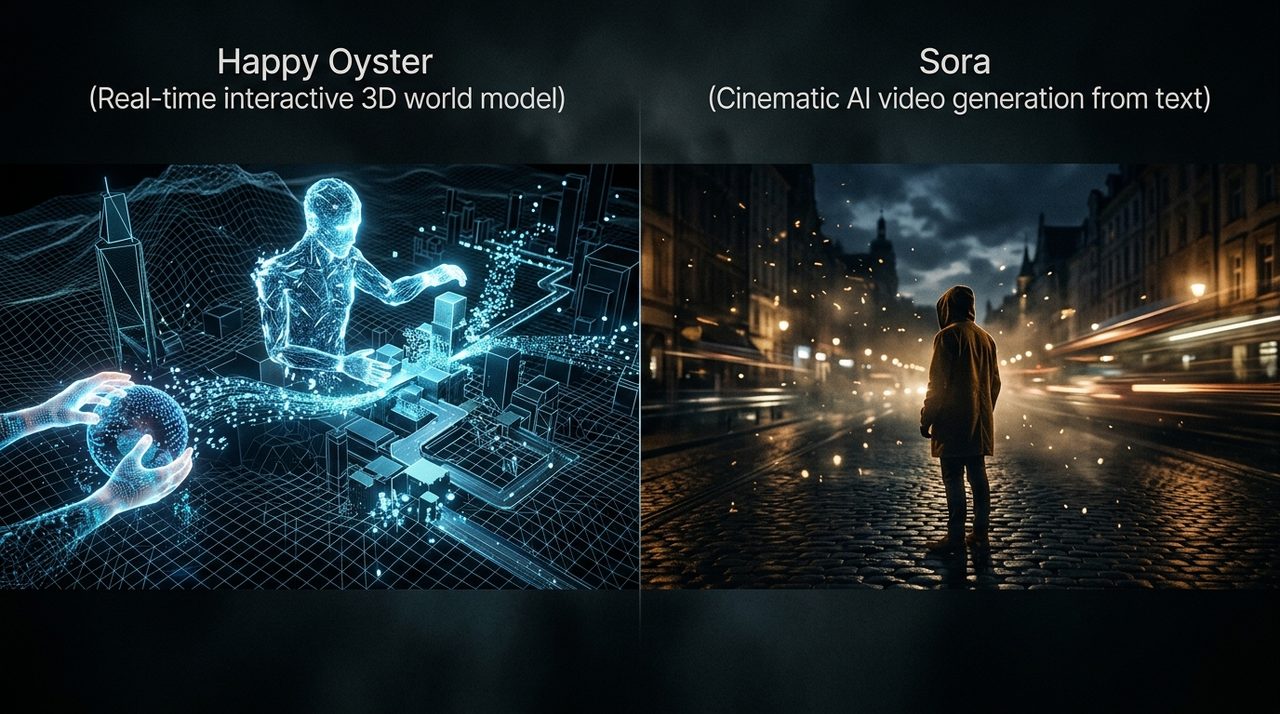
Happy Oyster vs Sora comparison showing active 3D world model versus discontinued video generator

Key facts

Quick facts

Sora status

Verified

Discontinued by OpenAI on March 24, 2026. App closes April 26, API closes September 24, 2026

Sora shutdown reason

Verified

Estimated $15M/day inference costs with only $2.1M total lifetime revenue; 66% download decline from peak

Happy Oyster status

Verified

Launched April 16, 2026 in limited early access by Alibaba ATH Innovation Division

Comparison notes

If you are searching for a comparison between Happy Oyster and Sora, the most important fact is that Sora is being shut down. OpenAI announced the discontinuation on March 24, 2026, with the app closing April 26 and the API following on September 24. Happy Oyster, meanwhile, just launched. But these two models were never direct competitors.

What happened to Sora

Sora was OpenAI's text-to-video generator, first announced in early 2024 and launched publicly in late 2025. Despite enormous initial hype, the product failed commercially. According to reporting by the Wall Street Journal and TechCrunch, Sora's estimated inference cost was approximately $15 million per day, while total lifetime in-app revenue reached only $2.1 million.

Downloads peaked at 3.33 million in November 2025 and fell 66% to 1.13 million by February 2026. The planned $1 billion Disney investment collapsed when Disney learned of the shutdown less than an hour before the public announcement.

OpenAI CEO Sam Altman made the decision to kill Sora, free up compute resources, and redirect them toward coding tools and enterprise customers, areas where the company faces intense competition from Anthropic's Claude Code and similar products.

Sora will continue as a research project focused on world models, with a successor product called Spud reportedly targeting a July 2026 release via API.

What Happy Oyster is

Happy Oyster, released April 16, 2026 by Alibaba's ATH Innovation Division, is a 3D world simulator. It generates interactive, explorable three-dimensional environments with two core modes: Directing (guided creation) and Wandering (free exploration). Built on a native multimodal architecture, it supports audio-video co-generation and real-time scene adaptation.

Happy Oyster is not a video generator. It creates 3D worlds, not flat video clips.

Why this comparison still matters

| Aspect | Happy Oyster | Sora | |---|---|---| | Status | Active (limited early access) | Discontinued (app closes April 26) | | Output type | Interactive 3D worlds | 2D video clips | | Audio | Native co-generation | Added in later versions | | Interactivity | Real-time exploration | Linear playback | | Business model | Not yet announced | Failed ($15M/day cost vs $2.1M lifetime revenue) | | Developer | Alibaba ATH Innovation | OpenAI | | Category | 3D world simulation | Video generation |

The comparison matters because Sora's failure provides an important lesson for the AI-generated content market. The raw cost of running video generation models at scale proved unsustainable for OpenAI. Happy Oyster, as a 3D world model, faces similar compute challenges. Alibaba's approach to commercialization will need to avoid the pitfalls that sank Sora.

The market gap Sora left

Sora's departure does not create a direct opportunity for Happy Oyster because they serve different needs. The gap Sora left in 2D video generation has been filled by Seedance 2.0, Kling 3.0, Veo 3, and Runway Gen-4, all of which surpassed Sora's quality before it shut down.

However, Sora's pivot toward "world models" for its research future is telling. OpenAI sees the same direction that Happy Oyster is pursuing: the future of generative AI may be in simulating interactive worlds rather than producing passive video clips.

What former Sora users should consider

If you used Sora for video generation, your direct alternatives are Seedance 2.0, Kling 3.0, Veo 3, and Runway Gen-4. Export your Sora content before the April 26 deadline.

If you are interested in the next generation of spatial AI content, whether for games, VR, or simulation, Happy Oyster represents an emerging approach worth following. Read What Is Happy Oyster? for a complete overview.

For evaluating the full range of post-Sora alternatives, Elser.ai provides cross-platform comparison tools for video and 3D generation models.

Mixed signal

Some facts are supported, but other details remain uncertain

Sora shutdown is confirmed and well-documented. Happy Oyster is in early access with limited public benchmarks.

Readers should expect careful wording here because public reporting confirms the topic, while some product details still need cautious treatment.

Recommended tool

Done comparing? Start creating.

Skip the wait — try AI video generation right now with a tool that is available today.

Powered by Elser.ai — works independently of any model discussed above.

Try AI Image Animator

Unlock the Happy Oyster Prompt Library

Get tested prompts, comparison cheat sheets, and workflow templates delivered to your inbox.

Free. No spam. Unsubscribe anytime.

FAQ

Frequently asked questions

Is Sora still available?

The Sora web and app experience will be fully discontinued on April 26, 2026. The API will close September 24, 2026. Export your content before these deadlines.

Why did OpenAI shut down Sora?

Sora cost an estimated $15 million per day to run but generated only $2.1 million in total lifetime revenue. Downloads fell 66% from peak. OpenAI reallocated compute to coding tools and enterprise products.

Is Happy Oyster a replacement for Sora?

Not directly. Sora generated 2D video clips. Happy Oyster generates interactive 3D worlds. They serve different use cases. For direct Sora replacements, consider Seedance 2.0, Kling 3.0, or Veo 3.