Veo 3 access
VerifiedFree for all Google account holders with 10 generations per month as of April 2026
Happy Oyster generates interactive 3D worlds with real-time exploration, while Veo 3 is Google's AI video generator with native audio and free access for all Google users.

Key facts
Free for all Google account holders with 10 generations per month as of April 2026
Limited early access only, no public API or free tier
Native audio generation with synchronized sound effects, ambient audio, and dialogue from text prompts
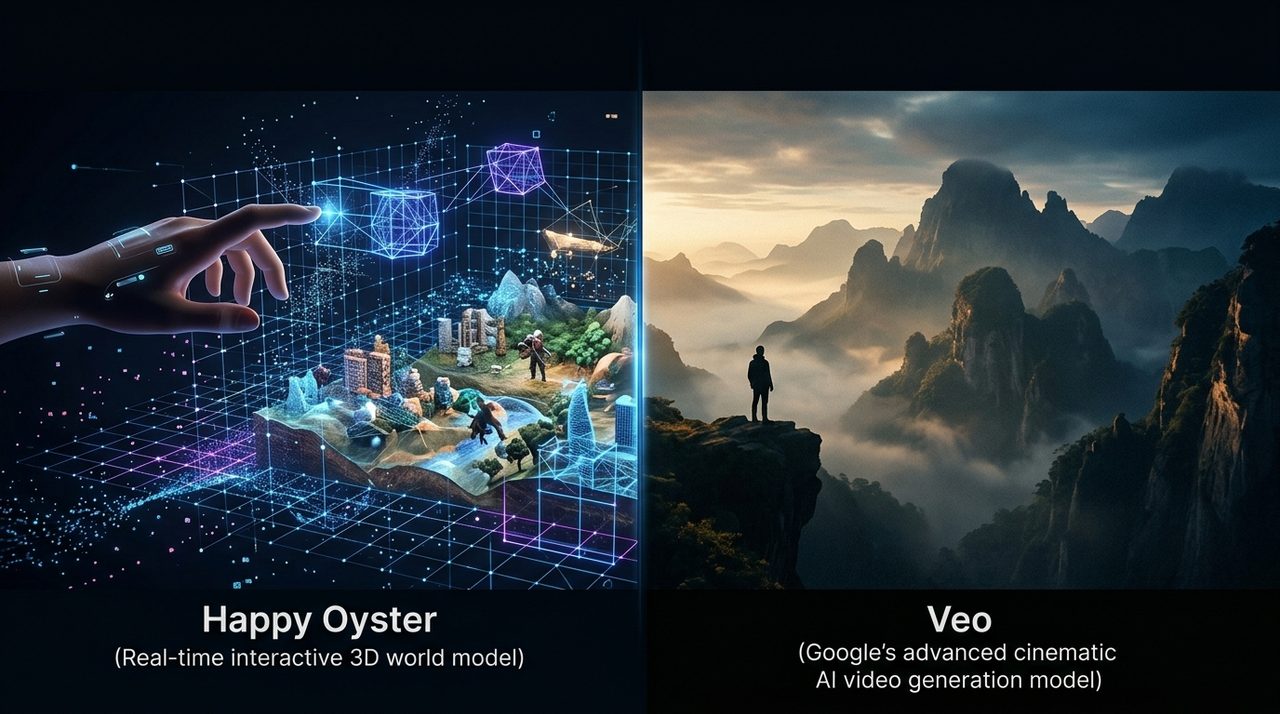
Happy Oyster and Veo 3 both feature native audio generation, but their outputs are fundamentally different. Happy Oyster creates interactive 3D worlds you can explore; Veo 3 creates video clips you can watch. Here is how they compare as of April 2026.
Happy Oyster, released April 16, 2026 by Alibaba's ATH Innovation Division, is a 3D world simulator. It generates three-dimensional environments with two core modes: Directing (creator-guided scene construction) and Wandering (free exploration). The model features native multimodal audio-video co-generation and real-time scene adaptation.
Veo 3, developed by Google DeepMind, is an AI video generator that converts text descriptions into realistic video clips with synchronized audio. Unlike earlier video models, Veo 3 produces sound effects, ambient audio, and even character dialogue natively from a single text prompt. The Veo 3.1 update in early 2026 improved temporal consistency and added vertical video support. As of April 7, 2026, Google opened free access to all personal accounts with 10 generations per month.
| Feature | Happy Oyster | Veo 3 / 3.1 | |---|---|---| | Output type | Interactive 3D worlds | 2D video clips (up to 8s) | | Resolution | Not specified | Up to 1080p (4K via upscale) | | Audio | Native co-generation | Native audio, dialogue, sound effects | | Lip sync | Not detailed | Full lip synchronization | | Interactivity | Real-time exploration | Linear playback | | Free access | No | 10 free generations/month for all Google users | | API access | Not yet | Available via Google AI Studio | | Safety measures | Not detailed | SynthID watermarking on all outputs | | Developer | Alibaba ATH Innovation | Google DeepMind |
Happy Oyster's strength is interactive 3D space. For any application where the user needs to move through, explore, or interact with generated content, video is insufficient. Game prototyping, VR experiences, architectural walkthroughs, and simulation training all require the spatial dimensionality that Happy Oyster provides.
The real-time adaptation capability creates a generative feedback loop: the world changes based on how you interact with it. This is fundamentally different from Veo 3's approach of generating a fixed clip from a prompt.
Veo 3's greatest advantage is accessibility. With free access for all Google account holders and integration into Google Vids (with up to 1,000 generations per month for AI Ultra subscribers), Veo 3 is the most accessible high-quality video generator available. No waitlist, no limited early access, just generate.
The native audio capability is well-implemented. Veo 3 produces realistic sound effects, ambient environmental audio, and character dialogue with lip sync, all from a single text prompt. For content creators who need quick, polished video with sound, this is a complete workflow in one generation step.
Google's SynthID watermarking system also addresses content provenance, marking all AI-generated videos for detection. This responsible AI approach matters for creators who need to comply with disclosure requirements.
The April 2026 release of Veo 3.1 Lite at less than 50% of the cost of Veo 3.1 Fast also makes it the most cost-effective option for high-volume video applications.
Veo 3 is a mature, widely available product with transparent pricing and massive distribution through Google's ecosystem. Happy Oyster is a cutting-edge 3D world model in limited early access. They exist at different points on the availability spectrum and serve different creative needs.
If you need video content today and want the lowest barrier to entry, Veo 3 is the practical choice. If you need interactive 3D environments and are willing to wait for broader access, Happy Oyster represents the next generation of spatial content creation.
For comparing AI creative tools across categories, Elser.ai offers evaluation workflows. Read What Is Happy Oyster? to understand Alibaba's new model, or see the Happy Oyster vs Runway Gen-4 comparison for another video generator matchup.
Mixed signal
Veo 3 features are well-documented by Google. Happy Oyster technical details are limited by early access status.
Readers should expect careful wording here because public reporting confirms the topic, while some product details still need cautious treatment.
Recommended tool
Skip the wait — try AI video generation right now with a tool that is available today.
Powered by Elser.ai — works independently of any model discussed above.
Try AI Image AnimatorGet tested prompts, comparison cheat sheets, and workflow templates delivered to your inbox.
FAQ
Yes. As of April 2026, all personal Google accounts get 10 free video generations per month via Veo 3.1. Paid plans offer more.
No. Veo 3 generates 2D video clips up to 8 seconds at 1080p resolution with native audio. It does not produce explorable 3D worlds.
Both. Veo 3 generates synchronized sound effects and dialogue. Happy Oyster also supports native audio-video co-generation.