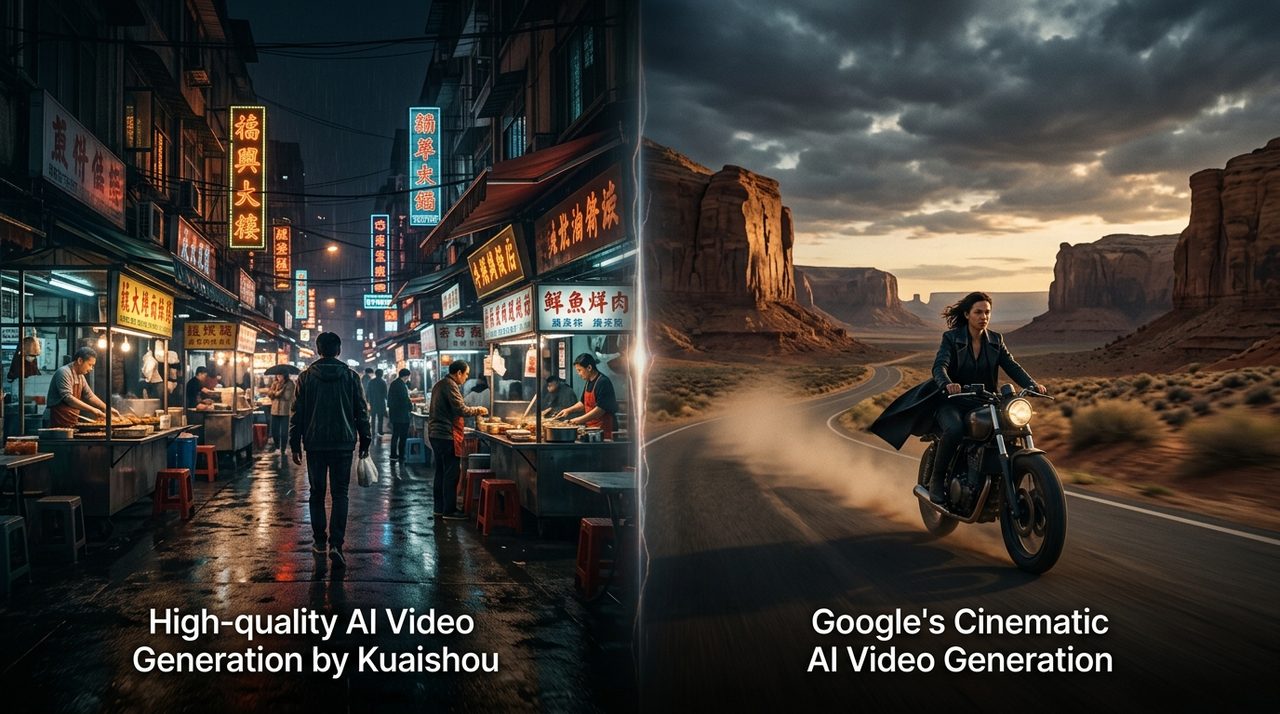
Kuaishou vs Google DeepMind

Kling AI vs Veo

Kling AI (High-quality AI video generation model by Kuaishou.) compared to Veo (Google's most advanced cinematic AI video generation model.).

Kling AI vs Veo

Kling AI and Veo target adjacent jobs but take different approaches. This page compares them side by side on output paradigm, access, capabilities, and positioning — based on vendor-stated claims as of 2026-04-21 / 2026-04-21.

At a Glance

Kuaishou

Kling AI

High-quality AI video generation model by Kuaishou.

  • Utilizes a self-developed 3D Variational Autoencoder (VAE) for synchronous spatiotemporal compression [1.1].
  • Natively generates multi-lingual, lip-synced audio from text without requiring separate audio files.
  • Features a unique 'Element' system allowing users to upload up to 4 reference elements to maintain character and object consistency.
See Kling AI details →

Google DeepMind

Veo

Google's most advanced cinematic AI video generation model.

  • First-party integration directly into YouTube Shorts, allowing millions to generate AI video backgrounds and cinematic elements natively.
  • Generates native, synchronized audio without requiring a separate post-processing sound model.
  • Understands advanced cinematic semantics and camera physics natively, accurately rendering specific commands like aerial tracking and rack focus.
See Veo details →

How They Compare

DimensionKling AIVeo
Modalitytext-to-video, image-to-video, text-to-imagetext-to-video, image-to-video, video-to-video
Release statusga (2024-06-10)ga (2024-05-14)
CapabilitiesText-to-Video Generation · Image-to-Video Generation · Multi-lingual Lip Sync · Cinematic Camera MovementsNative Audio Generation · Cinematic Camera Control · Image & Video Animation · Fast & Lite Modes
Max Resolution4K Ultra HD [1.8]4K (Standard/Pro), 1080p & 720p (Fast/Lite)
Frame Rate30fps to 60fps24 - 30 fps
Free Tier66 daily credits
ArchitectureDiffusion-based Transformer (DiT) / Multi-modal Visual Language (MVL)
Aspect Ratios16:9, 9:16
Base Duration4 to 8 seconds natively, extendable via API and looping

Which Should You Choose?

  • Pick Kling AI if you need: Utilizes a self-developed 3D Variational Autoencoder (VAE) for synchronous spatiotemporal compression [1.1]..
  • Pick Veo if you need: First-party integration directly into YouTube Shorts, allowing millions to generate AI video backgrounds and cinematic elements natively..
  • Both come from different vendors — consider your existing stack.

Related

Last verified: 2026-04-21 (Kling AI) · 2026-04-21 (Veo)