Primary competitor
VerifiedTencent HY-World 2.0, open-sourced on April 15, 2026, one day before Happy Oyster launched
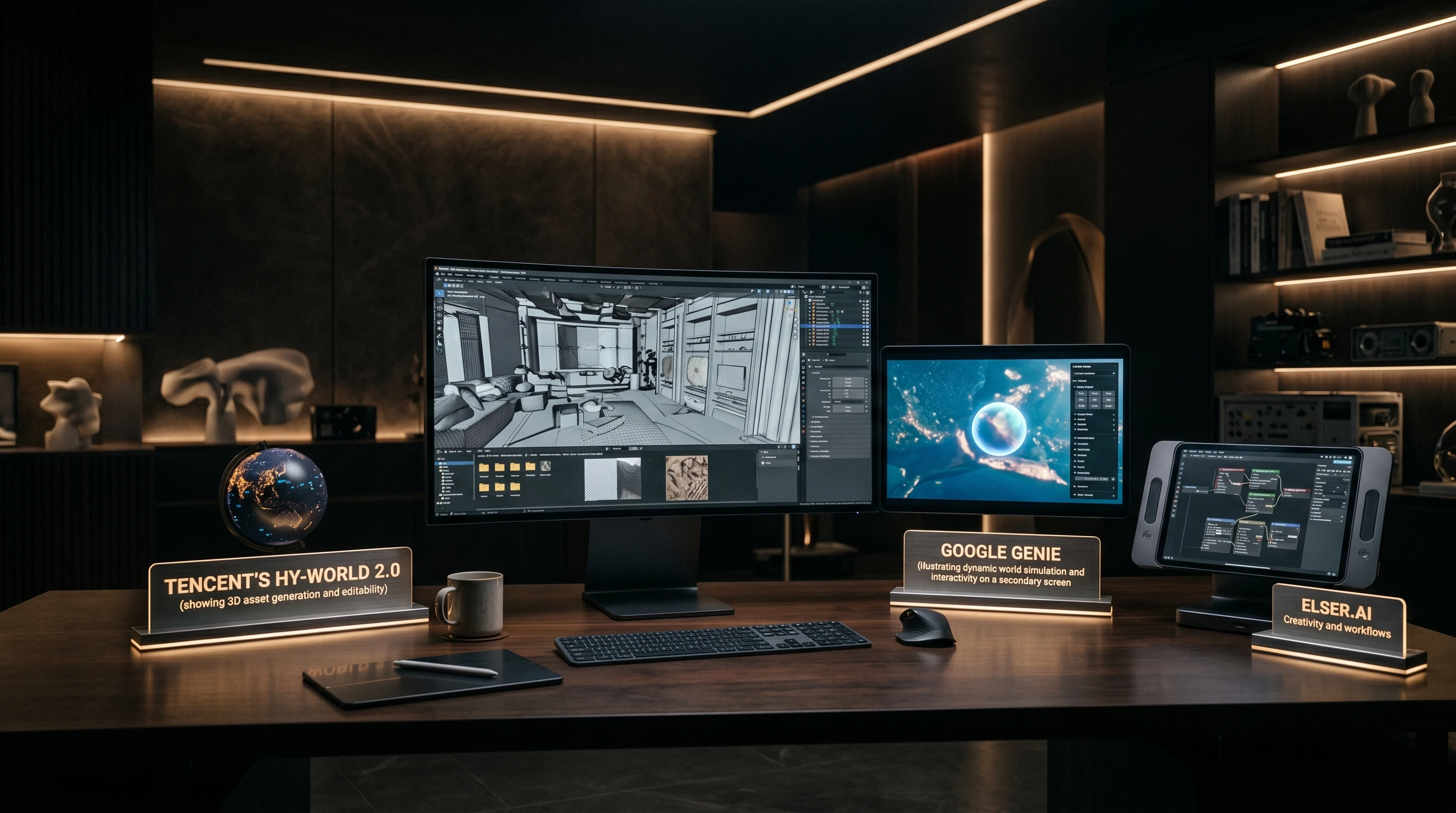
The strongest Happy Oyster alternatives include Tencent's HY-World 2.0, which is open source and outputs editable 3D assets, plus Google Genie for world simulation. Elser.ai provides practical creative workflows while access to these models remains limited.
Key facts
Tencent HY-World 2.0, open-sourced on April 15, 2026, one day before Happy Oyster launched
Open source on GitHub and Hugging Face with model weights and inference code
HY-World 2.0 outputs editable 3D meshes and Gaussian Splattings; Happy Oyster focuses on real-time interactive simulation
Google Genie, plus earlier world models like Cosmos and HY-World 1.5
If you are looking for Happy Oyster alternatives, the good news is that the 3D world model space is becoming competitive fast. The challenging part is that these tools take fundamentally different approaches to the same goal, so the right alternative depends on what you actually need.
Tencent's HY-World 2.0 is the most direct alternative to Happy Oyster. It was open-sourced on April 15, 2026, literally one day before Happy Oyster launched. The timing was not coincidental; both companies are racing to define the world model category.
What HY-World 2.0 does differently:
The tradeoff is that HY-World 2.0 requires serious hardware. The recommended pipeline needs GPUs with 40+ GB VRAM like an A100 or H100. The lightweight pipeline works on consumer GPUs with 24 GB VRAM like an RTX 4090.
Where Happy Oyster has an advantage is in real-time interactivity. The Directing and Wandering modes let you interact with worlds as they generate, rather than producing static 3D assets you edit afterward.
Google's Genie is another entrant in the world model space. It takes yet another approach, focusing on generating interactive environments from images and video inputs. Genie has been positioned more toward research applications and robotics training rather than creative content production.
Compared to Happy Oyster, Genie has less emphasis on real-time creative direction and more on learning physical world dynamics for AI training purposes. It is less directly useful as a creative tool for game dev or film production.
Before the April 2026 wave, several earlier world models existed:
The newer models, including both Happy Oyster and HY-World 2.0, represent a significant step forward from these earlier approaches.
If you need a working creative workflow today and cannot wait for world model access to broaden, Elser.ai provides tools that address overlapping use cases:
These tools do not replicate full 3D world simulation, but they serve the creative ideation and visual prototyping stages that many Happy Oyster users are looking for.
If you need editable 3D assets for a game engine, HY-World 2.0 is the strongest option and it is available now. If you specifically need real-time interactive world simulation, Happy Oyster has a unique approach but limited access. If you need practical visual content tools today, Elser.ai covers the creative workflow gap. For the latest on Happy Oyster access, check Try Happy Oyster or Happy Oyster Early Access.
Mixed signal
Competitor product details are verified from official sources and GitHub repos. Direct feature-parity comparisons should be treated cautiously since Happy Oyster is in limited early access.
Readers should expect careful wording here because public reporting confirms the topic, while some product details still need cautious treatment.
Recommended tool
Looking for something you can use today? Start with a public AI video workflow that is available now.
Powered by Elser.ai — available now without depending on official Happy Oyster access.
Try AI Image AnimatorGet tested prompts, comparison cheat sheets, and workflow templates delivered to your inbox.
FAQ
Tencent's HY-World 2.0 is the most direct competitor. It is open source, produces editable 3D assets (meshes and Gaussian Splattings), and ranked first on Stanford's WorldScore benchmark.
Yes. HY-World 2.0 is open source on GitHub and Hugging Face. It requires GPUs with 40+ GB VRAM for the full pipeline, or 24 GB VRAM for the lightweight version.
Happy Oyster focuses on real-time interactive 3D world simulation with Directing and Wandering modes. HY-World 2.0 focuses on generating editable 3D assets from text, images, or video that can be imported into game engines like Unity and Unreal Engine.