Architecture type
VerifiedNative multimodal architecture supporting multimodal understanding and combined audio-video generation
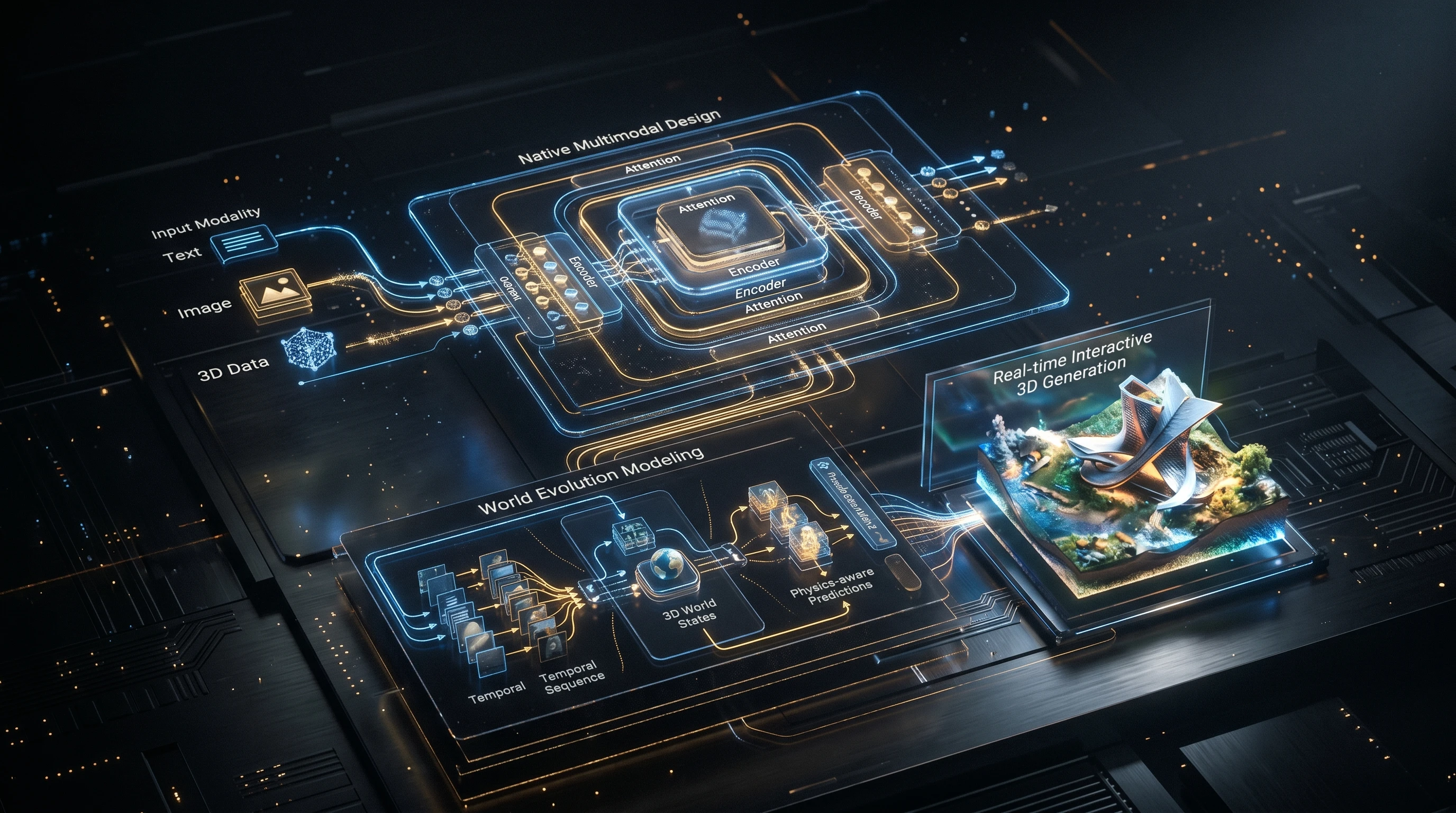
A technical analysis of Happy Oyster's model architecture, examining its native multimodal design, world evolution modeling approach, and how these enable real-time interactive 3D generation.
Key facts
Native multimodal architecture supporting multimodal understanding and combined audio-video generation
World evolution modeling over long time spans, shifting from passive generation to active simulation
Built by Alibaba's ATH Innovation Division (Token Hub), the same unit behind the Happy Horse video model
Detailed model specifications including parameter count, training data, and inference requirements have not been publicly released
Mixed signal
Architecture descriptions are based on Alibaba's official announcements. Detailed model specifications such as parameter counts and training data have not been publicly released.
Readers should expect careful wording here because public reporting confirms the topic, while some product details still need cautious treatment.
Happy Oyster represents a distinct architectural approach in the AI generation space. Rather than generating passive video sequences, it simulates interactive 3D worlds in real time. This technical analysis examines what is known about its architecture based on Alibaba's announcements and contextual analysis from the broader world model field.
Alibaba describes Happy Oyster as built on a "native multimodal architecture" that supports "multimodal understanding and combined audio-video generation." The word "native" is significant. It distinguishes Happy Oyster from pipeline-based approaches where separate models handle different modalities and are chained together.
In a pipeline approach, you might have:
A native multimodal architecture instead handles these within a unified model, which has several technical implications:
Cross-modal coherence. When audio and video are generated by the same model, synchronization is intrinsic rather than post-hoc. The model learns the relationship between visual events and their sounds during training.
Shared representations. A unified architecture can develop internal representations that span modalities. A visual event and its corresponding sound share latent space rather than being mapped between separate latent spaces.
Efficiency. Shared computation across modalities can be more efficient than running separate model forward passes for each output type.
The most architecturally distinctive aspect of Happy Oyster is what Alibaba calls "world evolution modeling over long time spans." This is what separates a world model from a video generation model.
Traditional video models predict the next frame based on previous frames and a conditioning signal (text prompt, image). The output is a fixed sequence with a predetermined length. World evolution modeling instead maintains a persistent model of the world's state and simulates how that state changes over time in response to user actions.
This requires:
HY-World 1.5 addresses similar challenges through its "Memory Reconstitution" mechanism, which dynamically rebuilds context from past frames to prevent geometric drift. Google's Genie 3 uses what it describes as real-time interactive generation at 24 FPS.
Happy Oyster's specific mechanisms for maintaining long-term world consistency have not been detailed in public documentation, but the architectural challenge is shared across the category: generating 3D environments that remain spatially and temporally coherent as users interact with them over extended periods.
The Directing and Wandering modes likely represent different input-output configurations of the same underlying model, rather than entirely separate architectures:
Directing mode accepts a rich stream of directorial commands (lighting adjustments, scene modifications, narrative direction) and generates world updates in response. The input bandwidth is high because the user is actively controlling multiple aspects of the generation.
Wandering mode accepts movement and exploration inputs, generating new environment areas as the user navigates. The input is simpler (direction and speed of movement) but the output must maintain coherence with everything previously generated.
Both modes share the core world evolution modeling and multimodal generation capabilities, which suggests a flexible architecture that can adapt its input processing while maintaining the same world simulation and rendering pipeline.
Several important architectural details have not been publicly disclosed:
The sister model Happy Horse is reported as a 15B-parameter transformer with 8-step denoising, but Happy Oyster's 3D world simulation requirements may demand a different architecture and scale.
For developers interested in technical integration, the API guide tracks access status. For the multimodal aspects specifically, see Happy Oyster multimodal architecture. Tools like Elser.ai can help compare technical capabilities across AI generation platforms.
This website is an independent informational and comparison resource and is not the official Happy Oyster website or service.
Recommended tool
Use a public-facing AI video tool while official details remain limited or unverified.
Powered by Elser.ai — does not rely on unverified official access.
Try AI Image AnimatorFAQ
Happy Oyster uses a native multimodal architecture that supports multimodal understanding and combined audio-video generation. Unlike pipeline-based approaches that chain separate models, Happy Oyster appears to handle multiple modalities within a unified architecture.
The parameter count has not been publicly disclosed. The sister model Happy Horse is reported as a 15B-parameter transformer, but Happy Oyster's specifications may differ given its 3D world generation capabilities.
Text-to-video models generate fixed sequences of frames. Happy Oyster uses world evolution modeling to simulate persistent, interactive 3D environments that respond to user input in real time. This requires maintaining world state and spatial coherence, which is architecturally distinct from sequence generation.
Get tested prompts, comparison cheat sheets, and workflow templates delivered to your inbox.