Core modes
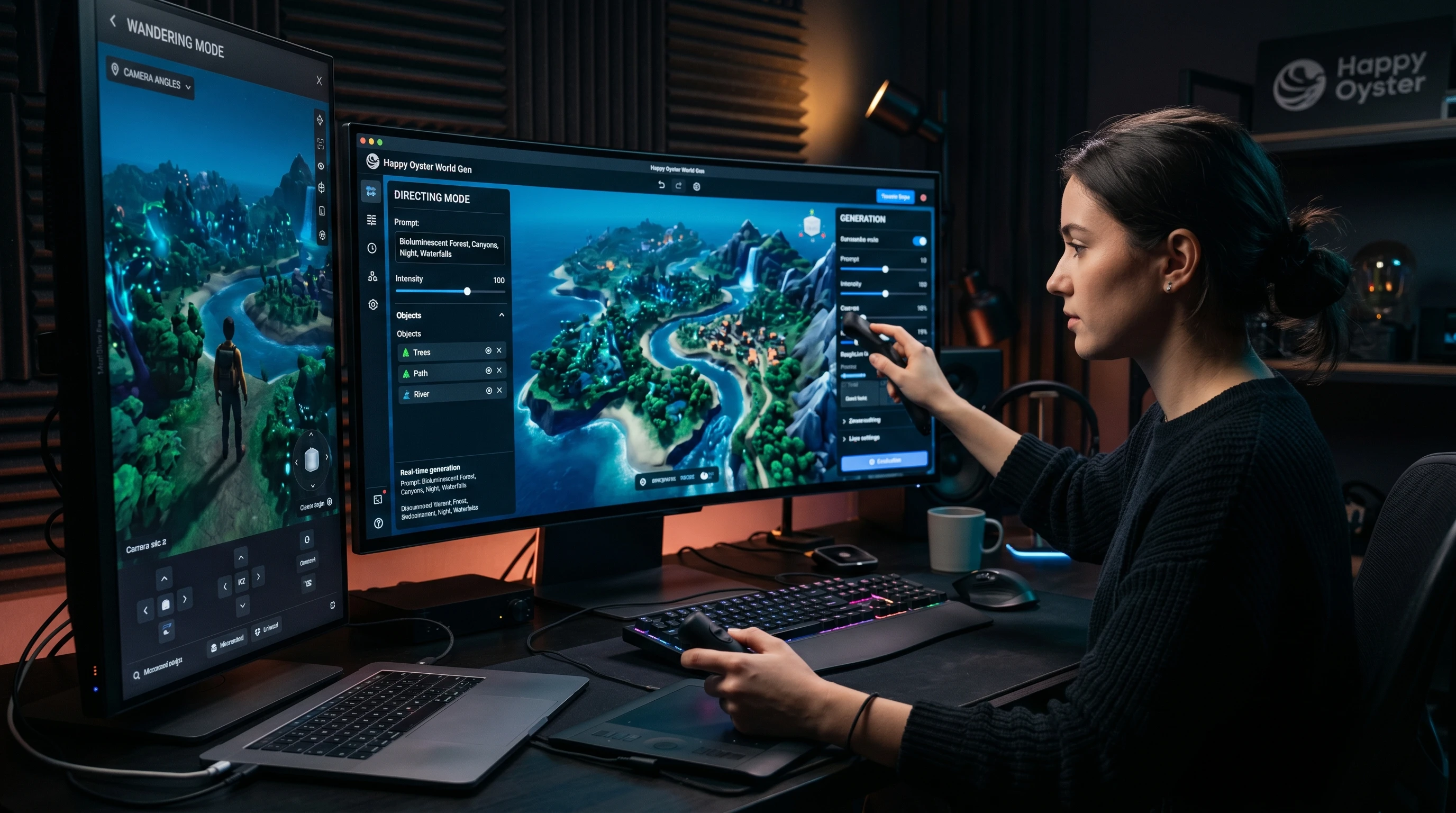
VerifiedHappy Oyster offers two modes: Directing for building and controlling scenes in real time, and Wandering for exploring endlessly expanding first-person environments
A hands-on tutorial explaining how to use Happy Oyster's Directing and Wandering modes to generate interactive 3D worlds, including prompt strategies and real-time scene control techniques.
Key facts
Happy Oyster offers two modes: Directing for building and controlling scenes in real time, and Wandering for exploring endlessly expanding first-person environments
Built on a native multimodal architecture supporting combined audio-video co-generation
Currently in limited early access with no public self-serve signup confirmed
Recommended tool
Use a public AI video workflow today while official release timing stays uncertain.
Powered by Elser.ai — a public-facing fallback while launch details stay fluid.
Try AI Image AnimatorMixed signal
Core mode descriptions are based on official Alibaba announcements. Specific workflow steps may change as the product evolves from early access.
Readers should expect careful wording here because public reporting confirms the topic, while some product details still need cautious treatment.
Happy Oyster is Alibaba's 3D world model, launched on April 16, 2026, by the ATH Innovation Division. Unlike traditional text-to-video tools that produce passive clips, Happy Oyster generates interactive, explorable 3D environments in real time. This tutorial walks through how 3D world generation works in both of its core modes.
Happy Oyster's approach to world generation revolves around two distinct interaction paradigms. Each serves a different creative workflow.
Directing mode gives you active control over the world as it generates. Think of it as a real-time production environment where you can adjust lighting, modify storylines, reposition objects, and reshape the physical environment while the scene unfolds. Alibaba describes this as shifting content production from "passive generation" to "active simulation of world evolution."
In practice, Directing mode is suited for creators who need precise control over scene composition. You are building a world and shaping its behavior simultaneously. The model adapts in real time based on your inputs, which makes it fundamentally different from rendering a fixed output from a prompt.
Wandering mode takes a single prompt and generates an endlessly expanding first-person environment. You explore the world as it builds itself around you. There is no fixed boundary or predetermined scene length. The model uses world evolution modeling over long time spans to maintain consistency as new areas generate.
This mode is closer to open-world exploration. You provide the initial creative direction, and the model sustains and extends the environment in response to your movement and interaction.
Because Happy Oyster is a world simulator rather than a video generator, prompt strategy differs from what you may be used to with tools like Runway or Pika. A few principles that apply based on what is currently known:
One of Happy Oyster's distinguishing features is its native multimodal architecture. Audio is not generated separately and layered on afterward. The model produces synchronized audio alongside the visual environment, which means ambient sounds, environmental audio, and scene-appropriate soundscapes are part of the generation output.
This matters for game development and film production workflows where audio-visual coherence is critical. Most competing world models, including Google's Genie 3 and Tencent's HY-World, do not offer native audio co-generation at this level.
Happy Oyster is in a limited early-access phase as of April 2026. There is no confirmed public signup flow or self-serve access. The pathway to large-scale commercialization has not been clarified by Alibaba.
If you are evaluating AI world generation tools and want to explore options while waiting for broader access, Elser.ai provides a workflow hub that tracks availability across multiple AI generation tools and can help you find alternatives that match your project needs.
This website is an independent informational and comparison resource and is not the official Happy Oyster website or service.
Get tested prompts, comparison cheat sheets, and workflow templates delivered to your inbox.
FAQ
Directing mode lets you build and control a physical world in real time, adjusting lighting, storylines, and objects on the fly. Wandering mode places you inside an endlessly expanding first-person environment generated from a single prompt.
Yes. Happy Oyster uses a native multimodal architecture that supports audio-video co-generation, meaning sound is produced alongside visual content rather than added separately.
As of April 2026, Happy Oyster is in a limited early-access phase. The pathway to broader public access has not been officially clarified.