World simulation approach
VerifiedHappy Oyster uses world evolution modeling over long time spans, creating persistent environments rather than static scenes
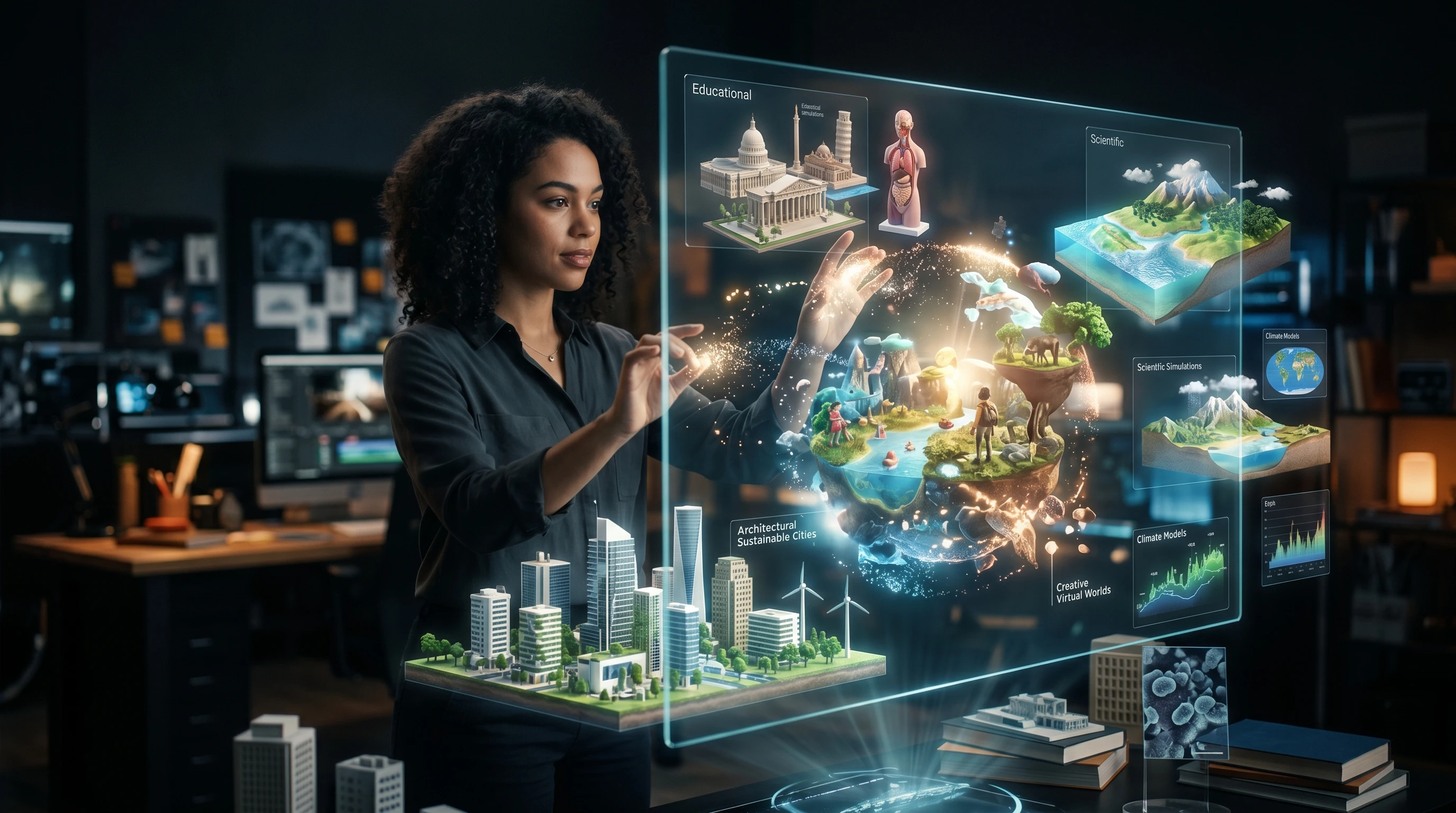
An overview of how Happy Oyster's world simulation capabilities extend beyond entertainment into education, architecture, simulation, and other virtual world creation applications.
Key facts
Happy Oyster uses world evolution modeling over long time spans, creating persistent environments rather than static scenes
Both Directing mode for controlled creation and Wandering mode for exploratory generation enable different virtual world creation workflows
The world models category has been described as crucial for training autonomous systems, education, therapy, and pushing toward AGI
Recommended tool
Use a public AI video workflow today while official release timing stays uncertain.
Powered by Elser.ai — a public-facing fallback while launch details stay fluid.
Try AI Image AnimatorMixed signal
Alibaba positions Happy Oyster for gaming and film content production. Broader virtual world applications are projected based on the model's general-purpose 3D generation capabilities.
Readers should expect careful wording here because public reporting confirms the topic, while some product details still need cautious treatment.
Happy Oyster generates interactive 3D environments in real time, and while Alibaba's launch messaging targets gaming and film production, the underlying world simulation technology has applications across a much broader range of fields. This page explores how virtual world creation with Happy Oyster extends beyond entertainment.
The key technical distinction is that Happy Oyster simulates world evolution rather than rendering static scenes. The model maintains internal consistency across time and space as environments generate and expand. This is what makes it a world model rather than a 3D rendering tool.
For virtual world creation, this means:
This foundation supports virtual world creation across multiple domains.
Interactive 3D environments have proven value in education and professional training. Happy Oyster's generation capabilities could accelerate the creation of:
Historical reconstructions. Generate explorable recreations of historical locations, periods, and events. Instead of reading about ancient architecture or historical battlefields, learners walk through them. Wandering mode's endless expansion means environments are not limited to a single room or building.
Scientific visualization. Create explorable representations of scientific concepts that benefit from spatial understanding: geological formations, ecological systems, molecular structures at macro scale, or astronomical environments.
Professional training simulations. Generate varied training environments for fields that require spatial awareness: emergency response scenarios, architectural walkthroughs, or urban planning simulations. Directing mode allows instructors to modify conditions in real time during training.
Architects and urban planners currently use specialized software to create 3D visualizations of proposed spaces. Happy Oyster offers a different approach:
This does not replace precision CAD tools for construction documentation, but it adds an AI-driven concepting phase that can inform design decisions earlier.
The world models paradigm has significance beyond content creation. As noted by researchers in the field, world models are considered crucial for training autonomous systems and advancing toward artificial general intelligence. Happy Oyster's world simulation capabilities are relevant to:
These research applications are speculative for Happy Oyster specifically, as Alibaba has focused marketing on content production, but the underlying technology supports them.
Happy Oyster is in limited early access as of April 2026. For organizations interested in virtual world creation:
This website is an independent informational and comparison resource and is not the official Happy Oyster website or service.
Get tested prompts, comparison cheat sheets, and workflow templates delivered to your inbox.
FAQ
While Alibaba targets gaming and film specifically, the underlying 3D world generation technology is general-purpose. Applications in education, architecture, simulation, and training are technically feasible but have not been officially demonstrated.
Happy Oyster uses world evolution modeling to maintain consistency over long time spans. The exact persistence and save/reload capabilities have not been fully documented during the early access phase.
Multiplayer or shared-world capabilities have not been confirmed. The demonstrated modes focus on single-user interaction through Directing and Wandering.