Primary target market
VerifiedAlibaba explicitly positions gaming as one of Happy Oyster's two primary content production targets alongside film
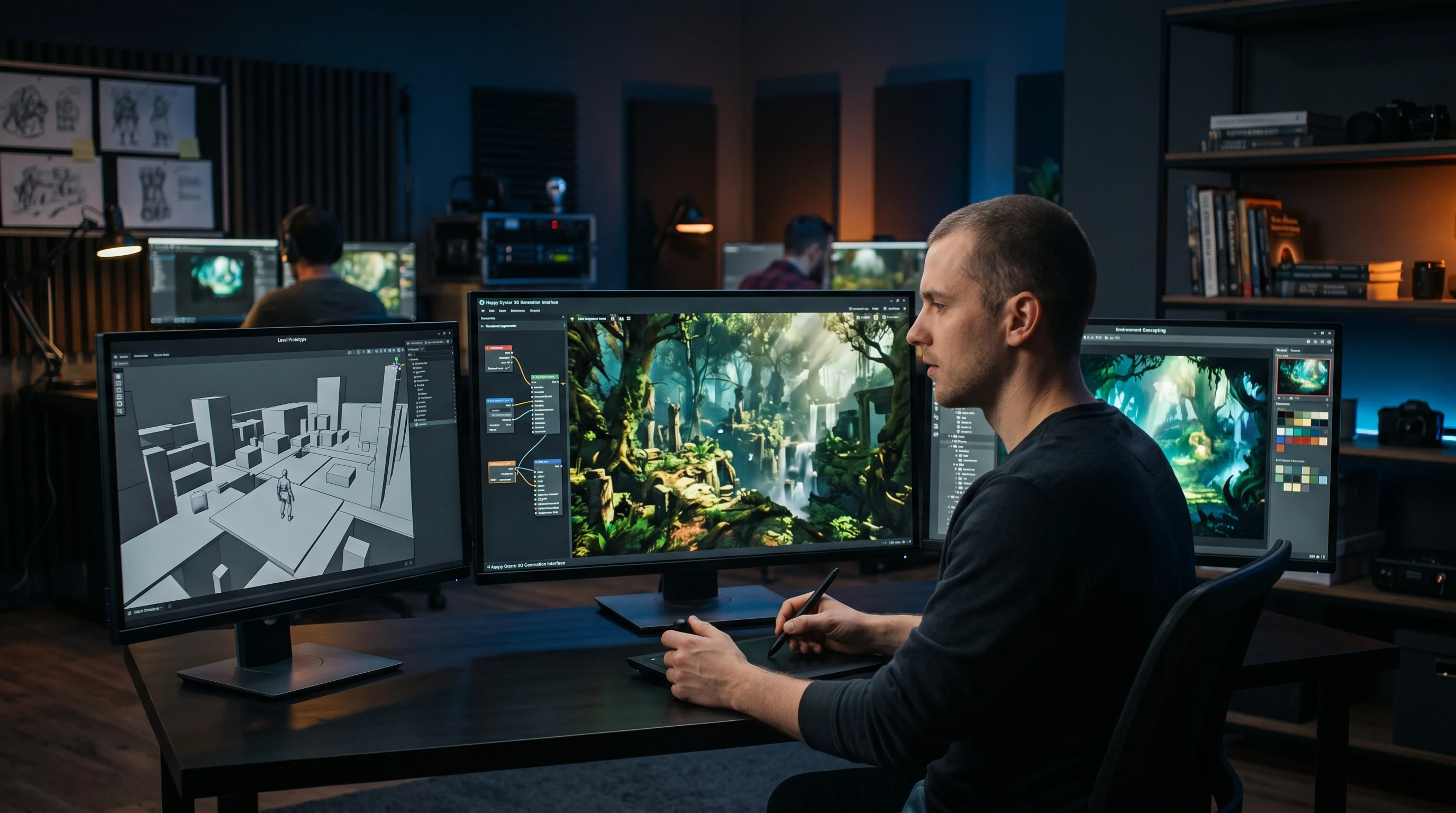
An overview of how game developers across studio sizes can leverage Happy Oyster's 3D world generation for level prototyping, procedural content, and environment concepting.
Key facts
Alibaba explicitly positions gaming as one of Happy Oyster's two primary content production targets alongside film
Positioned as a rival to Tencent's HY-World 2.0 and competing in a space that includes Google's Genie 3
Scenes adapt and change in real time based on user actions, which directly supports interactive game development workflows
Recommended tool
Use a public AI video workflow today while official release timing stays uncertain.
Powered by Elser.ai — a public-facing fallback while launch details stay fluid.
Try AI Image AnimatorMixed signal
Gaming is a confirmed target market. Specific game development workflows are projected based on the model's described real-time generation and interaction capabilities.
Readers should expect careful wording here because public reporting confirms the topic, while some product details still need cautious treatment.
Gaming is one of the two primary markets Alibaba targeted when launching Happy Oyster on April 16, 2026. The 3D world model generates interactive environments in real time, which opens several specific use cases for game developers across different team sizes and production stages.
The most immediate use case for game developers is rapid environment prototyping. Traditional blockout workflows involve placing primitive geometry in a game engine to test spatial relationships before committing art resources. Happy Oyster's Directing mode can compress this process:
For small studios and indie developers with limited environment art resources, this prototyping speed changes what is practical during pre-production.
Wandering mode generates endlessly expanding first-person environments from a single prompt, maintaining consistency over long time spans through world evolution modeling. This maps to several game development patterns:
Open-world exploration games. Generate vast environments that extend as the player explores. The model's ability to maintain coherence over extended generation windows addresses one of the hardest problems in procedural generation: consistency.
Roguelike level variation. Use prompts to define biome types and environmental themes, then generate unique level layouts for each run. The real-time nature means levels can be generated on the fly rather than pre-computed.
Environmental storytelling. Because Happy Oyster simulates world evolution rather than producing static scenes, generated environments can contain implied narrative through environmental detail, decay, growth patterns, and spatial relationships.
Game studios spending significant budgets on cinematic sequences can use Directing mode for:
The native audio-video co-generation means scratch audio for cinematics is available during the concepting phase, not as a separate production step.
The AI world model space now includes several options for game developers:
Happy Oyster differentiates through its native audio-video co-generation and the combination of Directing and Wandering modes, which offer both controlled and exploratory generation workflows in a single model.
For game developers evaluating multiple AI tools, Elser.ai provides a centralized platform for comparing generation capabilities and accessing different tools through a unified workflow.
This website is an independent informational and comparison resource and is not the official Happy Oyster website or service.
Get tested prompts, comparison cheat sheets, and workflow templates delivered to your inbox.
FAQ
Pricing and access tiers have not been announced. The model is in limited early access. When broader access opens, indie developers working with smaller teams would benefit most from rapid prototyping and environment concepting capabilities.
Export formats and game engine integration have not been confirmed. Current capabilities focus on real-time 3D environment generation and interaction. Check back for updates on pipeline integration specifics.
Traditional procedural generation uses algorithmic rules. Happy Oyster generates environments from natural language prompts with real-time directorial control. It is prompt-driven rather than code-driven, which changes the iteration speed and accessibility.