Release timing
VerifiedBoth models announced on April 16, 2026, making this a direct head-to-head launch
Happy Oyster and HY-World 2.0 are both 3D world models released April 16, 2026, but Happy Oyster focuses on real-time interactive simulation while HY-World 2.0 produces exportable 3D assets for game engines.
Key facts
Both models announced on April 16, 2026, making this a direct head-to-head launch
Produces editable 3D meshes and Gaussian Splattings exportable to Blender, Unity, and Unreal Engine
Generates interactive 3D worlds with real-time exploration via Directing and Wandering modes
HY-World 2.0 is open source on GitHub and Hugging Face; Happy Oyster is closed limited early access
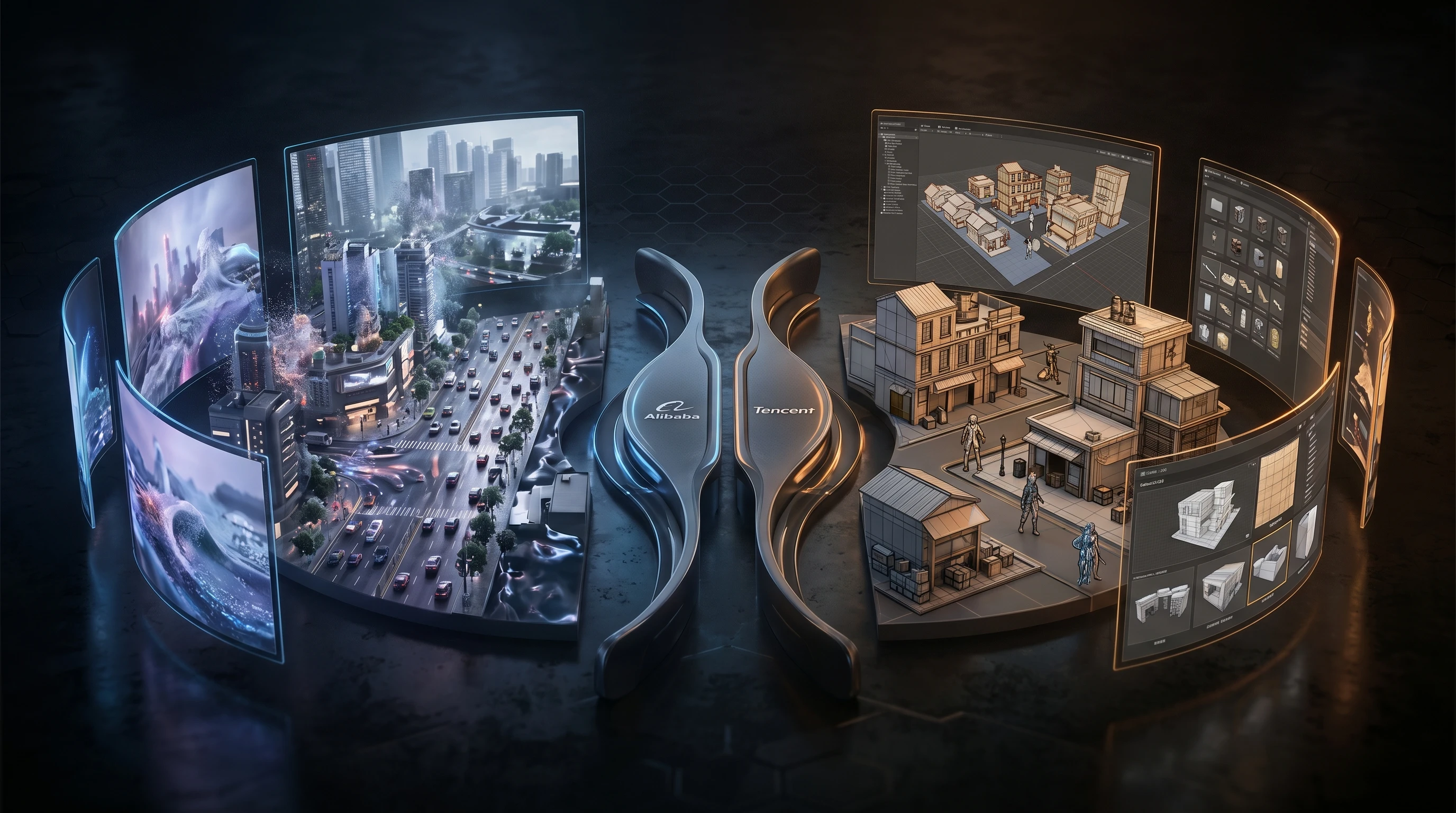
This is the most direct comparison on the site. Happy Oyster and HY-World 2.0 are both 3D world models from major Chinese tech companies, and both were announced on April 16, 2026. They represent Alibaba and Tencent's competing visions for the future of AI-generated 3D content.
Happy Oyster comes from Alibaba's ATH Innovation Division, the same team behind the viral Happy Horse video model. It generates interactive 3D environments that users explore in real time through Directing mode (creator-guided) and Wandering mode (free exploration). The emphasis is on simulation, with real-time scene adaptation based on user interaction.
HY-World 2.0 comes from Tencent's Hunyuan team. It is a multi-modal world model framework that accepts text, images, and video as input and produces 3D world representations, specifically meshes and Gaussian Splattings. Its core strength is generating editable, persistent 3D assets that can be imported directly into game engines like Blender, Unity, and Unreal Engine.
| Feature | Happy Oyster | HY-World 2.0 | |---|---|---| | Developer | Alibaba ATH Innovation | Tencent Hunyuan | | Output type | Interactive 3D worlds | 3D meshes and Gaussian Splattings | | Real-time interaction | Yes, with scene adaptation | No, produces static assets | | Game engine export | Not yet detailed | Blender, Unity, Unreal Engine, Isaac Sim | | Audio generation | Native audio-video co-generation | Not applicable | | Open source | No (limited early access) | Yes (GitHub + Hugging Face) | | Input modalities | Text (confirmed) | Text, single-view images, multi-view images, video | | 3D reconstruction | Not detailed | Yes, via WorldMirror 2.0 | | Core modes | Directing + Wandering | World Generation + World Reconstruction |
Happy Oyster's defining feature is real-time interactivity. Rather than producing a static 3D asset that you then load into a separate tool, Happy Oyster generates a world you can immediately explore and interact with. The model adapts scenes based on user behavior, creating a dynamic loop between generation and exploration.
The native multimodal architecture, with audio-video co-generation, also means that the generated worlds come with synchronized audio from the start. For applications like VR experiences, interactive storytelling, and game prototyping where immersion matters, this integrated approach has clear advantages.
Happy Oyster's sister model Happy Horse topped global video generation rankings, demonstrating the ATH team's strength in visual generation quality.
HY-World 2.0's strength is in producing production-ready 3D assets. Its output can be directly imported into professional tools. For studios that need to generate 3D content at scale and then refine it in existing production pipelines, this is the more practical workflow.
The open-source availability is a significant differentiator. Developers can inspect, modify, and build on HY-World 2.0 immediately. The model's four-stage World Generation pipeline (HY-Pano 2.0, WorldNav, WorldStereo 2.0, WorldMirror 2.0) and the WorldMirror 2.0 reconstruction system that predicts depth, normals, camera parameters, and point clouds in a single forward pass are all documented and accessible.
HY-World 2.0 also handles World Reconstruction from existing images and video, allowing conversion of real-world footage into 3D assets. This is a capability Happy Oyster has not yet demonstrated publicly.
Bloomberg reported that Happy Oyster is expected to bolster Alibaba's competitive edge against Tencent. The same-day launch is not coincidental. Both companies are racing to own the 3D world generation space, with implications for gaming, film, VR, and spatial computing.
The philosophical difference is real-time simulation (Happy Oyster) versus asset production (HY-World 2.0). Whether you need a world to explore now or assets to build with later determines which model fits your workflow.
HY-World 2.0 is available today as open source. Happy Oyster is in limited early access. If you need to start building now, HY-World 2.0 is the actionable choice. If real-time interactive 3D is your goal and you can wait for broader access, Happy Oyster is worth tracking.
For a broader view of the AI 3D landscape, Elser.ai provides comparison workflows across generation platforms. Learn more in What Is Happy Oyster? or see how it compares to video-focused models like Seedance 2.0 and Runway Gen-4.
Mixed signal
Both models launched on the same day. Direct technical comparison is limited by Happy Oyster's early access status and HY-World 2.0's partial open-source release.
Readers should expect careful wording here because public reporting confirms the topic, while some product details still need cautious treatment.
Recommended tool
Skip the wait — try AI video generation right now with a tool that is available today.
Powered by Elser.ai — works independently of any model discussed above.
Try AI Image AnimatorGet tested prompts, comparison cheat sheets, and workflow templates delivered to your inbox.
FAQ
HY-World 2.0 is open source with code and weights on GitHub and Hugging Face. Happy Oyster is currently closed source in limited early access.
HY-World 2.0 explicitly produces assets for Blender, Unity, and Unreal Engine. Happy Oyster's export capabilities have not been publicly detailed yet.
These are the most direct competitors on this site. Both are 3D world models from major Chinese tech companies, launched on the same day.
Happy Oyster emphasizes real-time scene adaptation and interactive exploration. HY-World 2.0 focuses on reconstruction and generation of static 3D assets rather than real-time simulation.